




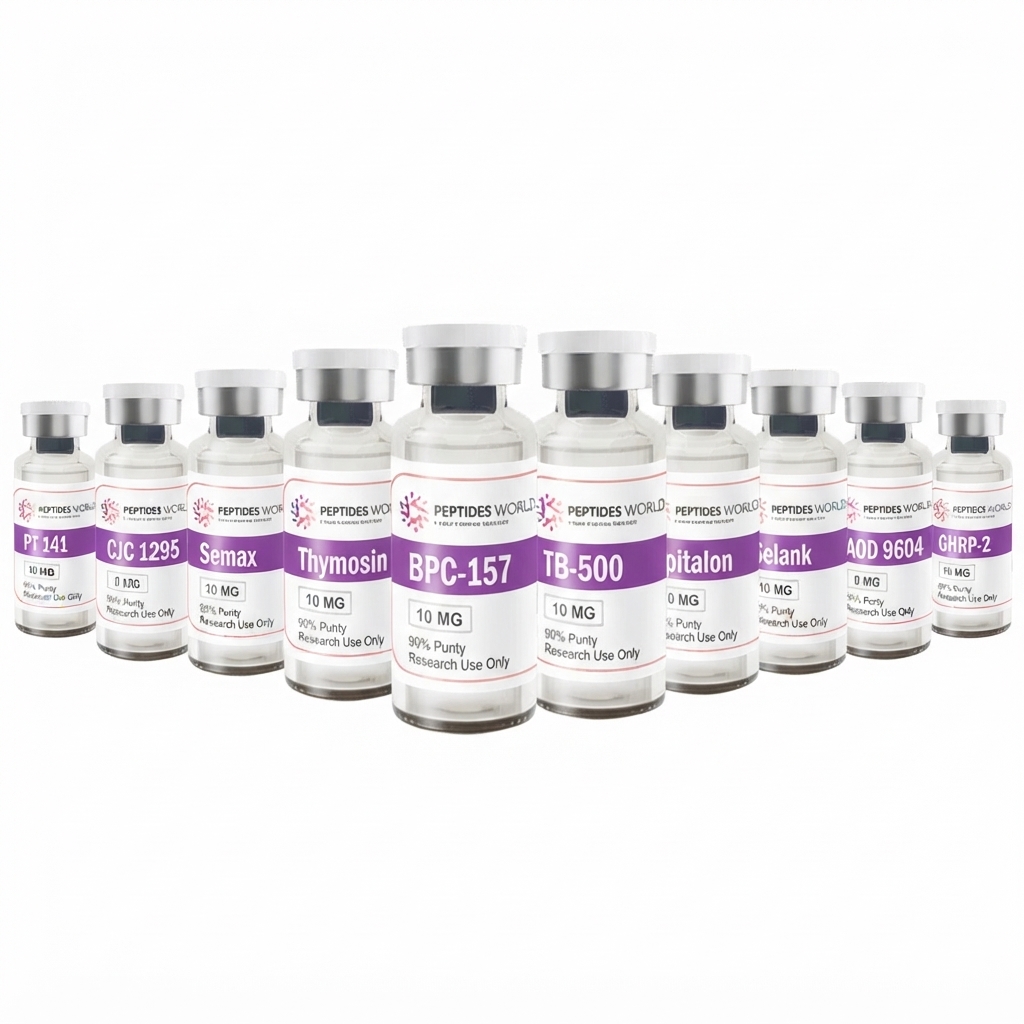

Peptides
DSIP (Delta Sleep-Inducing Peptide)
Sleep Regulation / Cognitive Support / Recovery
Available Forms: Injectable
DSIP is a naturally occurring nonapeptide that has been studied for its role in promoting deep, restorative sleep. It is a sleep quality optimizer — not a sedative or hypnotic. Effects are subtle and cumulative, supporting deeper delta wave sleep through HPA axis modulation.
Mechanism of Action
- Promotes Delta Wave Sleep — enhances deep restorative sleep stages
- Modulates HPA Axis — regulates cortisol and ACTH release patterns
- Neuroendocrine Balance — supports sleep-wake cycle regulation
Ideal Patient Profile
- Adults 30–65 with elevated stress or burnout; “wired but tired” phenotype
- Sleep fragmentation or chronic stress affecting sleep quality
Benefits
- May support deeper, more restorative sleep
- May support reduction of nighttime awakenings
- May support improved morning energy
- May support stress management capacity
Epithalon
Category: Longevity / Anti-Aging / Telomerase Activator / Bioregulatory
Available Forms: Injectable 2 mg/mL to start, then 10 mg/mL
Epithalon is a synthetic tetrapeptide studied for its ability to activate telomerase and regulate pineal gland function.
Available in both standard and high-dose formulations to support flexible longevity protocols.
Mechanism of Action • Stimulates telomerase enzyme; helps maintain telomere length; supports cellular longevity • Modulates melatonin production and supports circadian rhythm regulation • May influence aging-related gene expression and reduce oxidative stress markers
Formulation Notes • 2 mg/mL
Standard dosing for maintenance longevity and sleep-circadian support protocols: 10 mg/mL: High-dose formulation for intensive longevity protocols
Ideal Patient Profile • Adults 35+ with interest in longevity protocols | Poor sleep quality or circadian disruption • High oxidative stress lifestyle | Perimenopause/andropause | Immune aging concerns
Contraindications
- Active malignancy (theoretical concern — telomerase activity)
- Pregnancy or breastfeeding
- Patients under 25–30 without clinical indication
BPC-157 / TB-500 Combination
Available As Injectable
Pairs two of the most extensively studied healing peptides for synergistic musculoskeletal and tissue repair support without KPV or copper components.
- BPC-157: Promotes soft tissue regeneration, angiogenesis, GI support
- TB-500: Promotes cell migration, reduces adhesion formation, supports collagen production
Structure/Function Benefits
- Enhanced healing and recovery — synergistic effect on healing process
- Anti-inflammatory: Both reduce pro-inflammatory cytokines
- Muscle and body composition support
- Cardiovascular and GI health support
Performance Blend — CJC-1295 / Ipamorelin
Available As Injectable 2 mg-2 mg/mL
A growth hormone axis support combination. Best administered in the evening before sleep to align with the natural GH pulse.
- CJC-1295 (DAC-GRF): GHRH analog that enhances pulsatile GH secretion and protein synthesis
- Ipamorelin: Selective GHRP with minimal effect on cortisol or prolactin
Structure/Function Benefits
- Supports cardiovascular system function | Supports collagen production
- Supports reduction of fat storage | Supports natural growth hormone production
- Supports bone density, muscle growth and repair, sleep quality
- May support healthy libido and immune function | Supports energy levels
Fat Burner Plus Blend — AOD-9604 / MOTS-C / Tesamorelin / Ipamorelin
Available As Injectable combination 1.2 mg-2 mg-2 mg-2 mg/mL
An enhanced four-compound fat metabolism blend that adds Ipamorelin to the standard Fat Burner Blend for amplified growth hormone pulsatility, deeper sleep, and accelerated body composition changes. Indicated for patients seeking maximum fat reduction with comprehensive body composition optimization.
- AOD-9604 (1.2 mg/mL): Lipolysis support
- MOTS-C (2 mg/mL): Mitochondrial metabolic support
- Tesamorelin (2 mg/mL): Visceral fat reduction support
- Ipamorelin (2 mg/mL): Selective GH secretagogue for amplified GH pulse and enhanced sleep quality
Structure/Function Benefits — Enhanced vs. 3-Compound Blend
- All benefits of the Fat Burner Blend, plus:
- Amplified natural GH pulse supporting deeper sleep and recovery
- Enhanced lean muscle preservation during active fat loss
Improved exercise recovery and performance support
Clinical positioning: For patients who have plateaued on the 3-compound blend, patients with significant weight management goals, or patients who would benefit from the additional GH-axis support that Ipamorelin provides.
Recovery Blend — BPC-157 / TB-500 / KPV / GHK-Cu
Available As Injectable 3-3-3-10 mg/mL
This healing and regenerative blend combines four complementary peptides for comprehensive tissue repair, anti-inflammatory, and regenerative support.
- BPC-157 (3 mg/mL): Angiogenesis and soft tissue repair
- TB-500 / Thymosin Beta-4 (3 mg/mL): Cell migration, anti-inflammatory, collagen production
- KPV (3 mg/mL): Selectively anti-inflammatory in inflamed tissue; antimicrobial properties
- GHK-Cu (10 mg/mL): Copper-mediated tissue remodeling, collagen synthesis, antioxidant
Structure/Function Benefits
- Supports healing post-surgery, injury, and intense training
- Supports muscle healing, joint, ligament health, and skin inflammatory response
- Stimulates collagen and GAG synthesis for increased skin firmness
- Supports overall gut health | May support mood and comfort
Sermorelin / Ipamorelin Combination
Available As Injectable 3 mg-3.6 mg/5 mL
Pairs Sermorelin, a synthetic GHRH analog, with Ipamorelin, a selective GHRP, stimulating GH release through two complementary pathways for a stronger, more physiologic GH pulse.
Structure/Function Benefits
- Supports improved body composition (lean muscle mass, reduced body fat)
- May support accelerated healing from training, injury, or surgery
- Supports physical performance including strength and endurance
- Supports skin elasticity, hair health, and connective tissue integrity
- Supports sleep quality, energy, and mood stability
Dosing Guidance
- Standard: 0.1–0.2 mL SC once daily at bedtime
- Cycle: 3 months on / 1 month off; or 5 days on / 2 days off
- Monitoring: IGF-1, fasting glucose, and relevant labs during off periods
Tesamorelin / Ipamorelin Combination
Available As Injectable 2.4 mg-1.2 mg/mL
Combines Tesamorelin’s clinically demonstrated visceral fat-reducing effects with Ipamorelin’s selective rapid GH pulse. Provides amplified GH secretion with minimal cortisol or prolactin effect.
Structure/Function Benefits
- Supports significant reduction in visceral fat stores
- May maintain or increase lean muscle mass during fat loss
- Supports accelerated healing from training, injury, or surgery
- Supports physical performance, sleep quality, energy, and mood stability
Dosing Guidance
- Standard: 0.1–0.2 mL SC once daily at bedtime
- Cycle: 3 months on / 1 month off; or 5 days on / 2 days off
NAD+
Do you have it? Do you need it? How do you get it?
NAD refers to a cellular molecule called Nicotinamide Adenine. This exists in two forms in cells. One has been “oxidized” the other has been “reduced.” In case you did not take chemistry in high school (lucky you!), the term oxidized means it is able to react with other molecules, while reduced means it cannot. The oxidized or active form is NAD+ and the reduced or inactive form is NADH.
The chemistry lesson is over, let’s move to biology. NAD+ is regarded as a “co-enzyme” which means it works with other molecules to speed up chemical reactions. Although it is involved in several reactions, by far and away the most important is creating energy. Energy becomes available (is created) when a specific element – Phosphorous – is attached to a molecule of adenosine. When three molecules of phosphorous are attached to one molecule of adenosine, the entire molecule is very unstable.
Try to imagine balancing a plate on a broomstick on your nose, while riding a unicycle. When the plate falls – and you know it will – there will be a crashing sound when it hits the floor. That’s energy – biochemically speaking. This entire fabrication – plate, broomstick, unicycle – is called adenosine tri phosphate. Energy derived from the separation of one phosphate molecule fuels every aspect of the one hundred trillion cells in the human body.
Now imagine that as soon as one plate falls, you have to restore it to the end of the broomstick balancing on your nose while riding the unicycle. Quite a feat, huh? That’s where NAD+ becomes important.
That alone should be enough, but NAD+ does more – much more. One of those actions is regulation of our sleep cycle, called a circadian rhythm. As we move through the day, our natural reservoir of NAD+ is depleted which means we become tired and feel the need for sleep. While we sleep, we create more NAD+ which leads to more ATP which leads to more energy.
Another action of NAD+ is regulation of our stress response(s). As you may know, stress triggers release of a hormone – correctly called the “Stress Hormone.” It peaks when we awaken and declines throughout the day. Obviously, this correlates with NAD+.
NAD+ is also involved in at least two aspects of metabolic regulation. One is insulin sensitivity, which refers to the ability of insulin to pass glucose through a cell membrane into a cell. The other is breakdown and removal of fats.
The last example of the many uses of NAD+ in the body is that it protects nerve cells (neurons). This neuroprotective aspect plays a role in nerve conduction. Consider disease conditions such as multiple sclerosis, all forms of neuropathy, even cognitive decline.
As we age, production of NAD+ decreases. Energy decreases, cognition decreases, metabolism decreases, insomnia increases, and more. We call this normal aging.
To be clear, as we age many hormones decrease, including testosterone, estrogen, progesterone, and thyroid – not just this co-enzyme we call NAD+. But, if we are going to fight the aging process, it is important to include NAD+ in our weapons.
NAD+ can be supplemented in some people, but not by everyone. Those who should not have NAD+ supplementation include:
- People not yet at least 40 years of age. You don’t need it and won’t find a lot of benefit.
- Cancer patients: The purpose of chemotherapy is to prevent cancer cells from replicating. Since NAD+ encourages cells to grow, NAD+ must be blocked in cancer patients.
- Pregnancy and breastfeeding: If an embryo/fetus/newborn grows too quickly, defects and malformations are inevitable. No NAD+ for new or soon-to-be moms.
Some people may have NAD+ supplementation if there is close monitoring: Liver disease, kidney disease. Frankly, I discourage NAD+ use in these patients.
NAD+ supplementation can be accomplished in three ways:
- Oral – very ineffective, although some companies will eventually start offering it that way. Please don’t be fooled by slick advertising.
- IV administration – very effective, but very inconvenient and very expensive. V.s must be given very slowly – over a period of hours not minutes. If NAD+ is administered too quickly, we can expect the recipient to have nausea, flushing and anxiety. When administered this way, we suggest 250 mg of NAD+ in saline over four hours.
- Injection into muscle or the subcutaneous space. To avoid the side effects of too much, too soon, we administer about 25 mg into the hip. This can be repeated as frequently as 3 times per week, and the dose can be increased as tolerance is established – but never more than 100 mg.
Our program is a series of six injections, either twice or three times per week for two or three weeks. After that, a weekly maintenance dose is adequate.
If you would like to have more information, please contact us at info@ArizonaNaturopathicMedicine.com.